Open education is a philosophy of teaching and learning that can include resources, tools, and practices to facilitate collaboration and flexibility in order to maximize access to education for the greatest number of learners, within and without formal institutional environments.
OEGlobal, a worldwide community supporting open educators, has set out the following principles of open education:
- Community – unite people around a common purpose.
- Non-proprietary – resources aren’t mine or yours – they’re shared!
- Participatory and inclusive – anyone can play an active and participatory role.
- Transparency – visibility, no black box, anyone can see the inner workings and assumptions.
- Shared decision making and control – no hierarchical command and control.
- Customizable – can be built upon; adapted to fit personal/local needs.
- Access – everyone has access through open permissions.
- Collaborative – ability to work together and enhance each other’s work.
- Iterative – release early and often, rapid prototyping, learn by doing, continuous improvement.
- Meritocracy – good ideas can come from anywhere, value diverse perspectives.
What does Open Education look like in practice? #
Adapted from Kwantlen Polytechnic University, with a CC-BY-SA designation.
In practice, open education attempts to build opportunities for learners to:
- Access education, resources, and scholarship without financial, technical, or permission barriers
- Collaborate with others within classrooms, across institutions, and globally
- Create and co-create knowledge openly, rather than passively consuming content
- Integrate learning from formal education with knowledge gained in other contexts
Together, these principles shift education from a closed, one-directional model to an open, participatory one. Learners can access materials without permission or payment barriers, work together across traditional boundaries, actively create rather than passively receive knowledge, and connect classroom learning with knowledge gained elsewhere. In doing so, open education addresses financial, technological, geographic, and social barriers that may be limiting educational access and engagement.
These principles naturally overlap with other educational frameworks you may already use, such as active learning and Universal Design for Learning.
What is the impact of open education? #
Adapted from Kwantlen Polytechnic University, with a CC-BY-SA designation.
Open education creates meaningful change across multiple dimensions—from systemic improvements in access and affordability to transformation of day-to-day teaching and learning. Understanding these impacts helps clarify why open practices matter and how they can strengthen your work as an educator.
Democratizing Access to Knowledge #
The first infographic below illustrates the key areas where open education creates impact. By removing barriers and fostering collaboration, open education addresses some of education’s most persistent challenges—making learning more affordable, more accessible, and more inclusive. These changes benefit individual students while also contributing to broader educational equity.
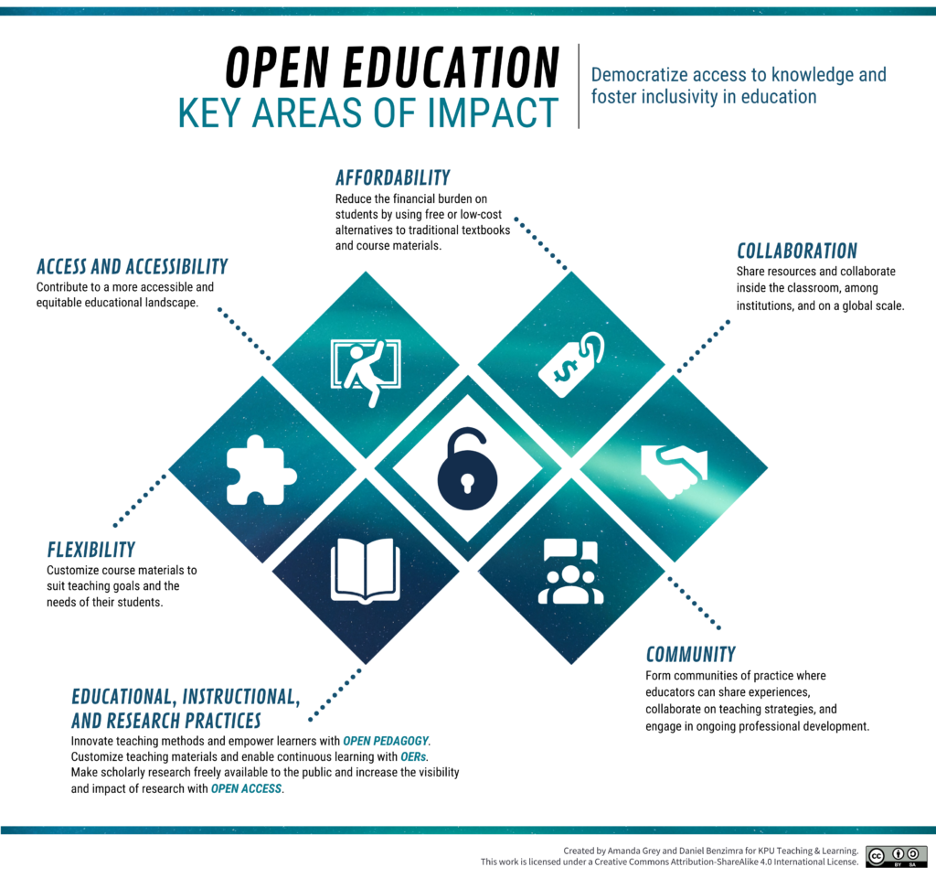
These impacts emerge from applying open principles consistently—ensuring materials are freely available, adaptable to diverse contexts, shareable across boundaries, and designed with learner needs at the center.
Transforming Teaching and Learning #
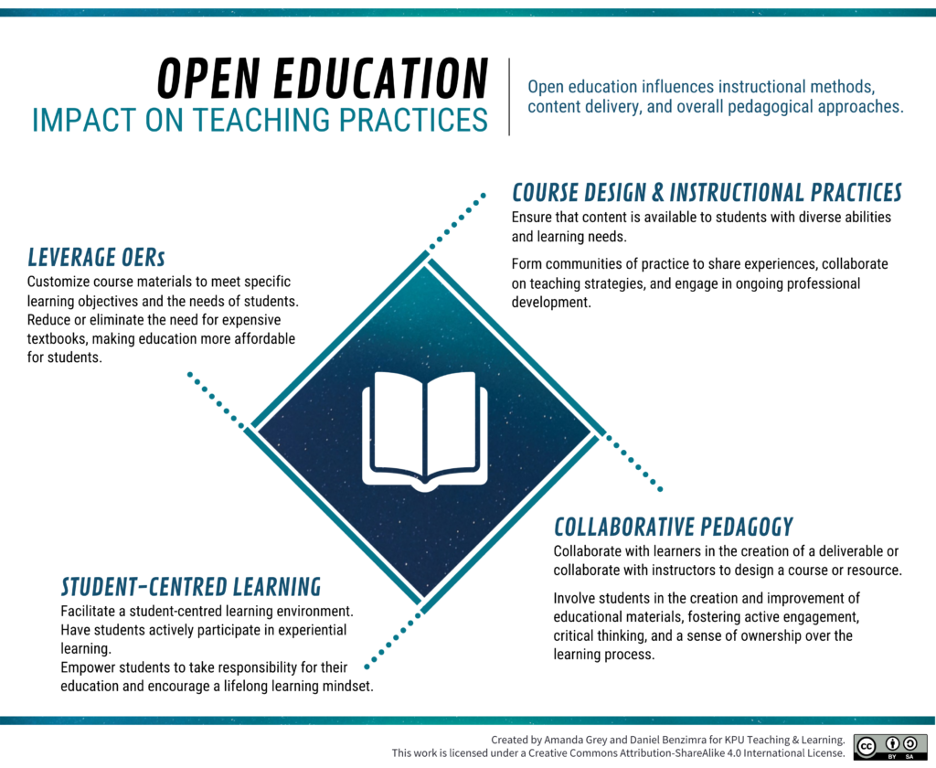
The second infographic below shows how open education specifically influences instructional methods, content delivery, and pedagogical approaches. When you engage with open practices, you’re not just changing what resources you use—you’re potentially reshaping how teaching and learning happen in your courses.
Open education supports teaching approaches that are more flexible, more collaborative, and more responsive to student needs. Whether you’re customizing an open textbook for your specific context, inviting students to contribute to course resources, or connecting with colleagues across institutions to improve shared materials, open practices create new possibilities for effective teaching.